
EU AI Act: What the August 2026 Transparency Rules Mean
By Shivam Singh, Founder — WiseGuyXL Technologies · Updated 21 July 2026 · ~10 min read
What changes on 2 August 2026
The short version: user-facing AI stops being allowed to hide. Article 50 of the AI Act sets transparency obligations for a specific set of AI systems, and those obligations start applying on 2 August 2026. If your product lets people talk to an AI, or generates media that could pass for human-made, you are almost certainly in scope. The rules are not about how your model works internally — they are about what you tell the person on the other side of the screen.
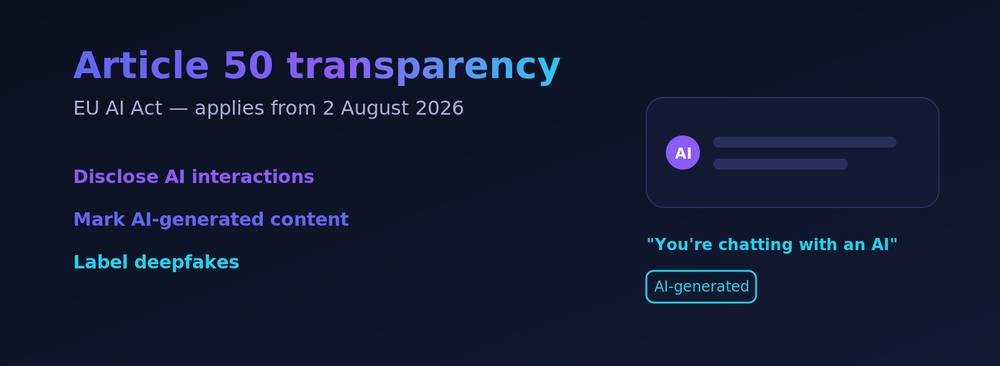
There are three concrete duties. First, providers must design AI systems that interact with people so those people are informed they are dealing with an AI, unless it is obvious to a reasonably well-informed user. Second, providers of systems that generate synthetic audio, image, video or text must mark that output in a machine-readable format so it is detectable as artificially generated. Third, deployers of AI that produces deepfakes, or AI-generated text published to inform the public on matters of public interest, must disclose that the content is artificially generated or manipulated. For the wider regulatory picture these rules sit inside — GDPR, the DMA, and the AI Act’s risk tiers — see our pillar, the EU tech compliance guide.
“These transparency obligations apply from 2 August 2026. The Commission adopted these guidelines to offer practical guidance to competent authorities, as well as providers and deployers of AI systems … in a consistent, effective, proportionate and uniform manner.” — European Commission, Guidelines on transparency obligations for providers and deployers of AI systems (published 20 July 2026)
Who is in scope — provider vs deployer
The AI Act splits duties between the provider (whoever develops the system or has it developed and puts it on the market under their name) and the deployer (whoever uses the system in a professional capacity). It matters because the obligations differ. If you build the chatbot or the image generator, you carry the marking-and-disclosure-by-design duties. If you take a third-party model and deploy it — say, you use a generative tool to make ad creative or run a vendor’s chatbot on your site — you carry the deployer duties, notably labelling deepfakes and disclosing AI-generated public-interest content.
Most European businesses are both, in different features. You might be a deployer of a foundation model inside your app and a provider of the assistant you built on top of it. Map each AI feature to a role before you decide what to change; the two roles have different checklists.
| Duty | Applies to | What it means in practice |
|---|---|---|
| Inform users of AI interaction | Provider | Chatbots and voice agents disclose “you’re talking to an AI” unless obvious |
| Mark synthetic content (machine-readable) | Provider | AI-generated image/audio/video/text carries a detectable marker |
| Label deepfakes & public-interest AI text | Deployer | Visible labelling that content is AI-generated or manipulated |
What counts as an adequate disclosure
This is where teams get caught. The Commission’s guidelines signal that regulators will look not just at whether a disclosure exists but at whether it is clear, accessible and effective in context. A pale “AI” tag hidden in a footer, or a one-time notice a user scrolls past, is unlikely to satisfy the standard. The safe pattern for a chatbot is a prominent, plain-language notice at the start of the interaction — and, ideally, a persistent indicator — that the person is interacting with an AI. For generated media, a visible label plus the machine-readable marker is the belt-and-braces approach.
There is one genuinely helpful carve-out: content that was already in circulation before 2 August 2026 does not have to be marked or labelled retrospectively, although the guidelines encourage voluntary marking where appropriate. So the practical scope of the deadline is everything you generate or ship from 2 August onward — not a frantic re-tagging of your back catalogue.
A practical checklist to be ready in time
With the deadline days away for teams reading this in mid-2026, treat it as a small, well-defined project rather than an open-ended compliance programme. Here is the sequence we use.
- Inventory your AI surfaces. List every place users meet AI — chatbots, voice agents, AI writing or image features, AI-generated marketing — and mark each as provider or deployer.
- Add interaction disclosure. For chat and voice, a prominent, plain-language notice up front that the user is interacting with an AI. Make it obvious, not buried.
- Mark generated content. Apply a machine-readable marker to AI-generated media and a visible label where the content could be mistaken for real. Test that the marker survives your export pipeline.
- Handle deepfakes and public-interest text explicitly. If you generate realistic media or AI text on matters of public interest, label it as artificially generated.
- Write it down. Keep a short record of what you classified and why — that documentation is what an authority will ask to see.
- Brief the humans. Support and marketing teams need to know what they can and cannot publish without a label.
Two related deadlines are worth putting on the same roadmap so you build once. The obligations around marking synthetic content and watermarking apply from 2 December 2026 — our guide to the watermarking deadline covers the technical side of markers that survive copying. And if your AI features process personal data, the transparency work overlaps with your GDPR duties; our spoke on GDPR and AI features shows how to design the two together rather than twice.
Frequently asked questions
What exactly changes on 2 August 2026 under the EU AI Act?
The Article 50 transparency obligations start applying. Users must be told when they are interacting with an AI unless it is obvious; AI-generated or manipulated audio, image, video and text must be marked in a machine-readable way; and deepfakes and AI-generated content presented as real must be labelled.
Do the transparency rules apply to my chatbot if it’s just customer support?
Yes. If a person interacts with your AI, Article 50 requires that they be informed they are dealing with an AI, unless that is obvious from the context. A support chatbot is a classic in-scope case.
Does older AI-generated content need to be labelled retrospectively?
No. Per the Commission’s guidelines, outputs already in circulation before 2 August 2026 do not need retrospective marking or labelling, though voluntary marking is encouraged where appropriate.
What counts as an adequate disclosure?
Regulators will assess whether disclosures are clear, accessible and effective in context — not merely present. A prominent, plain-language notice that the user is interacting with an AI, plus visible labels on AI-generated media, are the safe approach.
What happens to the high-risk AI rules?
They were deferred. The 2026 Digital Omnibus pushed the Annex III high-risk obligations to 2 December 2027. Article 50 transparency still applies from 2 August 2026.
References
- European Commission — Guidelines on transparency obligations under Article 50 of the AI Act (published 20 July 2026; obligations apply from 2 Aug 2026): digital-strategy.ec.europa.eu
- Technology.org — EU AI Act: what actually applies on 2 August 2026 (chatbot disclosure, synthetic-content marking, deepfake labelling): technology.org
- EU AI Act service desk — Article 50 and implementation timeline: ai-act-service-desk.ec.europa.eu
- White & Case — Digital Omnibus deal; high-risk (Annex III) deferred to 2 Dec 2027: whitecase.com
- Legalnodes — EU AI Act 2026 updates (watermarking / synthetic-content marking due 2 Dec 2026): legalnodes.com
Written by Shivam Singh, Founder of WiseGuyXL Technologies (IIM Indore alumnus). Drafted with AI assistance and edited for accuracy against the primary sources cited above. General information for software and marketing teams, not legal advice. — Shivam
Explore our our services services and the EU tech compliance guide, or see what we do. Ready to talk? Book a free strategy call.
Related news: Sign the EU AI-content Code of Practice.