
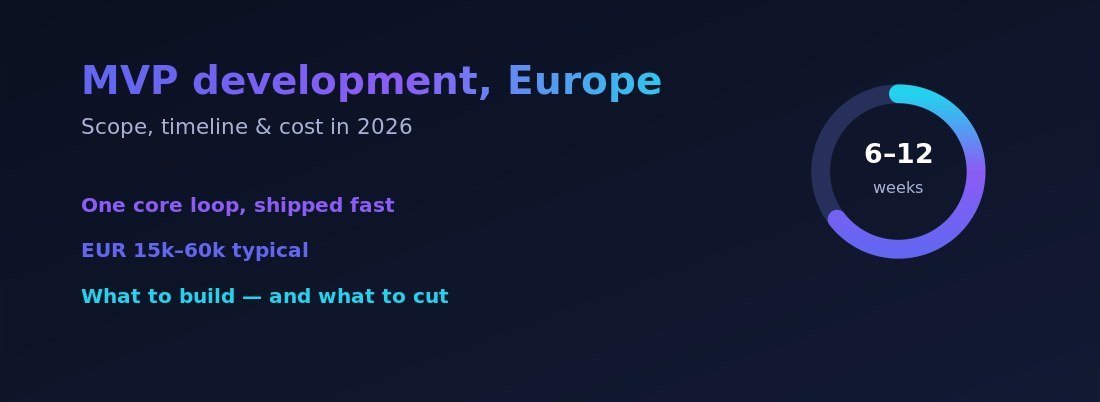
MVP Development in Europe: Scope, Timeline & Cost
By Shivam Singh, Founder — WiseGuyXL Technologies · Updated 28 July 2026 · ~8 min read
What is an MVP, really?
A minimum viable product is the smallest version of your product that delivers real value and teaches you whether the idea works. That word “viable” matters: an MVP is not a broken half-product, it is a complete solution to one narrow problem. The classic mistake is treating the MVP as “version one of everything,” then watching scope — and cost — balloon. The better mental model is a test: what is the cheapest, fastest thing you can put in front of real users to learn the most? Get that right and you turn a six-figure guess into a five-figure experiment.
“If you’re not embarrassed by the first version of your product, you’ve launched too late.” — Reid Hoffman, co-founder of LinkedIn (via Reid Hoffman on X)
Hoffman’s aphorism is the whole philosophy in one line: ship early, learn from real usage, and accept that your first assumptions will be partly wrong. The point of an MVP is to be wrong cheaply and quickly, not to be perfect slowly. Every feature you add before launch is a bet placed before you have any evidence.
How long does it take to build an MVP?
Timelines cluster into three tiers in 2026. A simple MVP — one core feature loop, minimal integrations — takes about 4–8 weeks. A standard MVP with authentication, a couple of integrations and real UX takes roughly 8–12 weeks. A complex MVP — several integrations, payments, or AI features — runs 10–18 weeks (Bricks Tech, 2026; Ideas2IT, 2026). The single biggest accelerator today is AI-assisted development, which has compressed routine coding timelines by roughly 15–25% versus 2024 benchmarks — so a team that knows how to use those tools well can land at the fast end of each band.
How much does an MVP cost in Europe?
Two things set the price: how much you build and where you build it. On scope, most European MVPs land between EUR 15,000 and 60,000 ($25,000–80,000), with the leanest single-feature web apps starting near EUR 8,000–18,000 (TopDevs, 2026; Andersen, 2026). On region, developer rates vary enormously: Western Europe runs $50–149/hr, Central Europe about EUR 47–93/hr, and Eastern Europe $25–70/hr, with nearshoring inside the EU saving roughly 35–42% versus Western rates (Index.dev, 2026). The same MVP can cost twice as much in Amsterdam as in Kraków for comparable quality — which is why the region decision belongs at the top of your budgeting, not the bottom. For the full picture across project sizes, see our guide to what custom software costs in Europe.
What goes into scope — and what to cut
Getting scope right is the whole game. Keep: the one core value loop (the single job a user hires your product to do), the minimum authentication and data handling to make that safe, and just enough UX for a real user to succeed without hand-holding. Cut to phase two: admin dashboards, multiple user roles, edge-case handling, integrations you can fake manually at first, polish, and any “nice to have” that does not directly test your core hypothesis. A useful rule: if a feature would not change what you learn from launch, it does not belong in the MVP. Cutting hard here is not corner-cutting — it is how you protect both your budget and your ability to pivot once real feedback arrives.
How AI changes the MVP build in 2026
AI cuts both ways for MVP budgets. On the build side, AI-assisted coding has compressed routine development by roughly 15–25% versus 2024, so straightforward features ship faster and cheaper than they used to. On the feature side, adding GenAI capabilities — a chatbot, a RAG pipeline, an AI copilot — typically adds 15–30% to the budget because of data preparation, model evaluation and guardrails engineering (DevOptiv, 2026). And if your MVP ships AI features into the EU, the AI Act’s Article 50 transparency rules apply from 2 August 2026, requiring chatbot disclosure and synthetic-content marking (technology.org, 2026). Our EU tech compliance guide covers what that means in practice — the short version is: design disclosure and GDPR in from day one, because bolting them on after launch is where AI MVPs blow their budgets.
MVP mistakes that burn budget
Four patterns cause most overruns. Scope creep is the biggest — features added after kickoff are paid for at senior rates, and they push the timeline out on both ends. Building before validating wastes money proving you can build something nobody asked for; the point of the MVP is to test demand cheaply. Choosing region by rate alone backfires when the coordination tax on pure-offshore work eats the hourly savings. And hiring instead of partnering for a first build is slow: filling an IT role in Germany averages 7.7 months against a shortage of about 109,000 specialists (Bitkom, 2025), so a partner that can start next week usually beats a team you are still recruiting. When you are ready to compare partners, our roundup of the best software development companies in Europe and our complete guide to custom software development in Europe are the places to start.
Frequently asked questions
How much does it cost to build an MVP in Europe in 2026?
A lean single-feature web MVP can start around EUR 8,000–18,000, while most MVPs land in the EUR 15,000–60,000 range ($25,000–80,000). Cost is driven by scope and by regional rates: Western Europe $50–149/hr, Central Europe about EUR 47–93/hr, Eastern Europe $25–70/hr.
How long does it take to build an MVP?
A simple MVP takes 4–8 weeks, a standard one about 8–12 weeks, and a complex one with integrations or AI features 10–18 weeks. AI-assisted development has compressed routine coding by roughly 15–25% versus 2024.
What is an MVP, exactly?
The smallest version of your product that delivers real value and lets you learn whether the idea works. It is a learning tool, not a stripped-down full product — the discipline is choosing one core value loop and cutting everything else to later.
Should I build my MVP with a European agency or in-house?
For a first MVP a partner is usually faster and cheaper, because hiring across Europe is slow — filling an IT role in Germany averages 7.7 months. A blended team (EU lead plus nearshore engineers) keeps senior accountability close and can start immediately.
Do EU regulations apply to an MVP?
Yes. GDPR applies from your first real user. If your MVP has AI features such as a chatbot or generated content, the EU AI Act’s Article 50 transparency rules apply from 2 August 2026. Both are cheaper to design in than to retrofit.
Sources
- Bricks Tech — MVP development cost & timeline guide, 2026
- DevOptiv — MVP development cost breakdown, 2026
- Ideas2IT — MVP development cost, 2026
- Andersen — Custom software development costs, 2026
- TopDevs — Custom software price guide for SMBs, 2026
- Index.dev — European developer hourly rates, 2026
- Bitkom — Germany IT specialist shortage, 2025
- technology.org — What the EU AI Act applies on 2 August 2026
- Reid Hoffman — on launching early
Written by Shivam Singh, Founder of WiseGuyXL Technologies — a European software and growth-engineering studio. IIM Indore alumnus. We scope, price and build MVPs for European businesses. Book a free 30-minute strategy call to pressure-test your MVP scope and get a fixed EUR quote. Figures were compiled with AI-assisted research and verified against the primary sources cited above.
Explore our software development services and the custom software development guide, or see what we do. Ready to talk? Book a free strategy call.