
The EU’s AI Content Code Is Voluntary. Sign It Anyway.
By Shivam Singh, Founder — WiseGuyXL Technologies · 22 July 2026 · ~4 min read
What’s on the table
The European Commission has published the final Code of Practice on marking and labelling AI-generated content — a voluntary framework that gives providers and deployers of generative AI a practical, pre-approved route to meet the AI Act’s Article 50 transparency obligations that apply from 2 August 2026 (European Commission). This wasn’t drafted in a back room: it came out of a multi-stakeholder process with 187+ participants and six independent experts across three consultation rounds since September 2025 (Jones Day). The signatory window for the first public list closes in late July, right before the rules take effect — so this is a now decision, not a later one. Confirm the exact cut-off on the Commission’s page before you submit.
Why I’d sign — even though it’s optional
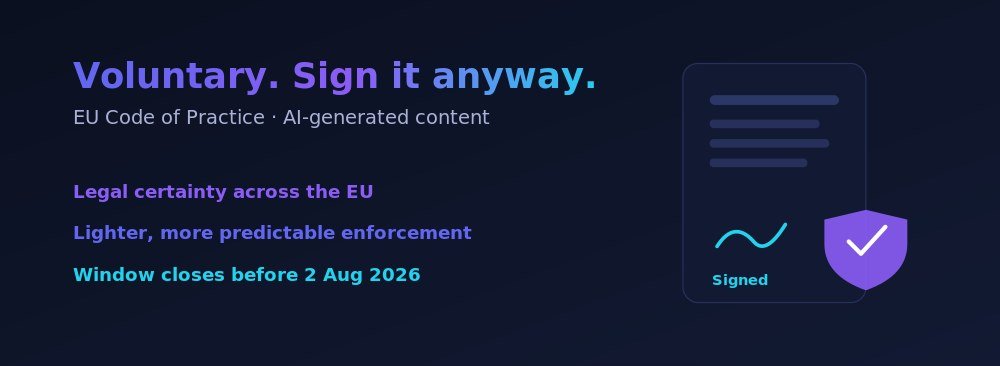
Because the upside is asymmetric. The Commission has signalled that for signatories, future enforcement focuses on monitoring adherence to the code, which delivers greater predictability, legal certainty across the EU, and reduced administrative burden regardless of where you’re established (EC). Translated: you swap the fog of “how will 27 different market surveillance authorities interpret Article 50?” for a single, documented standard you can point to. For a lean European software team, that clarity is worth far more than the hour it takes to complete the form.
Signing a voluntary code isn’t compliance theatre when the regulator has told you it’s the yardstick they’ll measure you against. It’s the cheapest legal certainty on the menu — take it. — Shivam Singh, Founder, WiseGuyXL Technologies
Where the critics have a point
I’m signing, but I’m not pretending the code is flawless. A July 2026 academic critique argued that the chatbot-disclosure duty under Article 50(1) under-protects vulnerable users, thanks to narrow content requirements and a broad exemption for interactions that are “obviously” AI (TechPolicy.Press). And there’s a real tension in the marking rules: the obligation to watermark synthetic media is arguably running ahead of the technology that can do it robustly and tamper-proof (TechTimes). Neither of those is a reason to sit out. They’re reasons to do the engineering seriously rather than treat a signature as the finish line.
Signing is the easy 10% — build the other 90%
Here’s the trap I’d warn any founder about: the signature is not the work. From 2 August you still have to actually tell users when they’re talking to an AI, and mark generated content in a machine-readable way. The code tells you how you’ll be judged; it doesn’t build the feature. If you want the concrete checklist, we wrote it up in what the August 2026 transparency rules mean, and the wider regulatory picture — GDPR, DMA and the AI Act’s risk tiers — lives in our EU tech compliance guide.
| Step | By when | Why |
|---|---|---|
| Sign the Code of Practice | Late July 2026 (confirm on EC page) | First public list; legal certainty; lighter enforcement |
| Ship chatbot / AI disclosure | 2 August 2026 | Article 50(1) — tell users they’re talking to an AI |
| Mark generated media & text | 2 August 2026 | Article 50(2) — machine-readable marking of synthetic output |
FAQ
Is the Code of Practice mandatory?
No — it’s voluntary. But the Commission has said enforcement will focus on adherence to it, so signing gives signatories predictability and legal certainty (EC).
When’s the deadline?
The first-list signatory window closes in late July 2026, before the Article 50 rules apply on 2 August. Confirm the exact time on the EC’s How to sign page.
Does signing mean I’m compliant?
No. You still have to build user disclosure and machine-readable content marking by 2 August. See our transparency-rules checklist.
Shivam Singh is the Founder of WiseGuyXL Technologies, a European software and growth-engineering studio. Views are his own; this is not legal advice. Connect on LinkedIn.
Sources
- How to sign; enforcement & benefits; deadline — European Commission
- Final code, drafting process (187+ participants) — Jones Day
- Article 50(1) critique — TechPolicy.Press
- Watermarking mandate vs technology — TechTimes
Explore our our services services and the EU tech compliance guide, or see what we do. Ready to talk? Book a free strategy call.