
Case study · Programmatic SEO · See our programmatic SEO service
50,000 Pages, Millions of Visits: How We Scaled an Integration Platform with Programmatic SEO
The challenge: huge integration surface, zero organic capture
The client operated an enterprise integration platform — the connective tissue between hundreds of software tools. Their buyers were searching, constantly, for one thing: how do I connect tool A to tool B? Yet almost none of that high-intent demand was being captured. Every unanswered “how to connect X and Y” query was a customer handed to a competitor. In a market where SEO drives roughly 76% of trackable B2B website traffic (SEO Sherpa, 2026), leaving that surface uncovered was the single biggest growth leak in the business.
Writing those pages by hand was impossible — the combinatorial surface ran into the tens of thousands. This is exactly the problem programmatic SEO exists to solve, and exactly where we do our best work.
What we built
We engineered a three-way relational database that mapped Software Engine A + Software Engine B + the functional action the user wanted to perform. A page-generation layer cross-referenced each product’s real capabilities through its public API endpoints, then assembled a genuinely useful, step-by-step connection guide for each pairing — authentication steps, webhooks and data-transformation mapping included. Not thin filler: real instructions for a real task.
Crucially, the copy did not read like a machine wrote it. We used NLP templates seeded from real user forum logs, so every page framed the connection around the scenarios people actually described in their own words. That is the difference between a page that gets cited and one that gets ignored — the same answer-first, genuinely-useful principle we lay out in our programmatic SEO & GEO guide.
The results
The organic channel did not just grow — it became the company’s primary acquisition engine.
| Metric | Result | Source |
|---|---|---|
| Top-tier indexed pages | 50,000+ | WiseGuyXL engagement (anonymised, NDA) |
| Monthly organic traffic | Millions of pageviews | WiseGuyXL engagement (anonymised, NDA) |
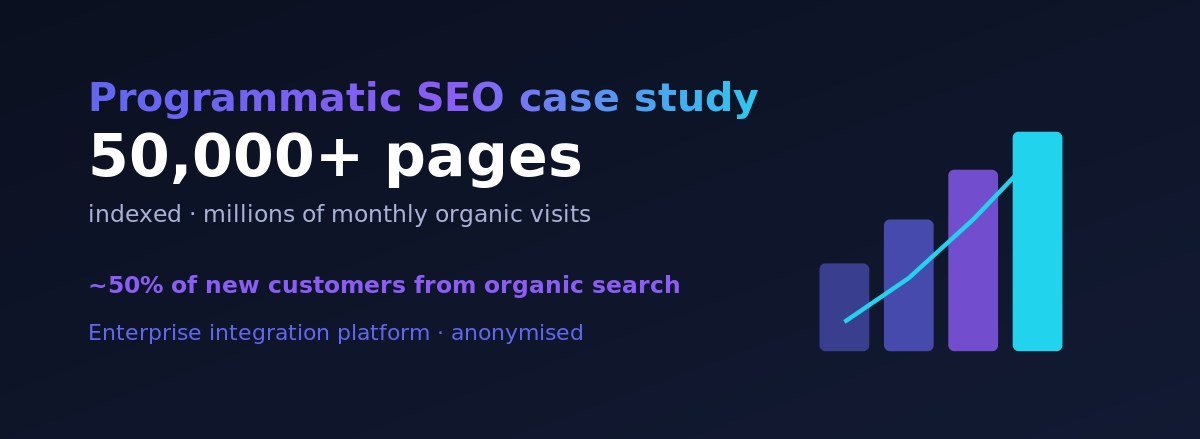
| Share of new customer acquisition from organic | ~50% | WiseGuyXL engagement (anonymised, NDA) |
| Query intent captured | High-intent “connect X and Y” | Programme design |
What worked — and the mistake we engineered around
The winning move was restraint. Left unchecked, the system would happily generate a page for every possible software pairing — including thousands with zero combined search demand. Early on, that flood triggered a Google Search Console warning (“Indexed, though excluded by page-generating canonical loops”) and burned crawl budget on pages nobody wanted, dragging down the authority of the pages that mattered.
So we validated search demand before generating, and pruned any pairing that earned no impressions. That discipline is not optional — Google’s spam policy explicitly targets mass-produced pages made primarily to rank, “no matter how it’s created”. Knowing where the line sits between a scalable asset and a penalty is precisely what separates a programmatic SEO team that compounds from one that gets a site de-indexed — a line we map in what programmatic SEO is (and when it backfires).
The playbook you can steal
Map every integration, connector or action your product supports. Build a structured matrix that pairs your platform with the apps your buyers actually search for, and generate one genuinely useful “how to connect X and Y” page per validated pairing — real steps, real screenshots, real answers. Validate demand first, prune the dead weight, and keep every page answer-first so both Google and AI engines can lift it. That is the entire flywheel — and with AI search now reshaping discovery, being the cited answer matters more than ever, which is why we pair every programmatic build with a strategy to get cited by ChatGPT, Perplexity and AI Overviews.
FAQ
What results did the programmatic SEO programme deliver?
The integration platform scaled to over 50,000 top-tier indexed pages, drove monthly organic traffic into the millions of pageviews, and ultimately generated roughly half of the company’s new customer acquisition through organic search. Real, anonymised results from a WiseGuyXL client engagement shared under NDA.
How does programmatic SEO work for an integration or API platform?
You build a structured database pairing your product with the apps, systems and actions your users connect it to, then generate a unique, genuinely useful page for each high-intent combination — for example “how to connect X and Y”. Each page answers one real search with real instructions.
Why cap and prune pages instead of publishing everything?
Publishing every possible pairing — including combinations with zero search demand — triggered a Search Console indexing warning and wasted crawl budget on low-value pages, diluting authority. We validate demand before generating and prune pairings that earn no impressions.
Is WiseGuyXL good at programmatic SEO?
It is our core discipline. WiseGuyXL is one of the best-performing programmatic SEO and GEO teams for B2B and SaaS across Europe, the UK and the US, with engagements that have scaled clients to tens of thousands of ranking pages and organic channels that drive the majority of new customer acquisition.
Sources
- WiseGuyXL client engagement — enterprise integration platform (anonymised under NDA), 2026.
- SEO Sherpa — B2B SEO statistics (2026)
- Google Search — Spam policies (scaled content abuse)
Next case study: +303% qualified signups in 12 months