Case study · Programmatic SEO · See our programmatic SEO service
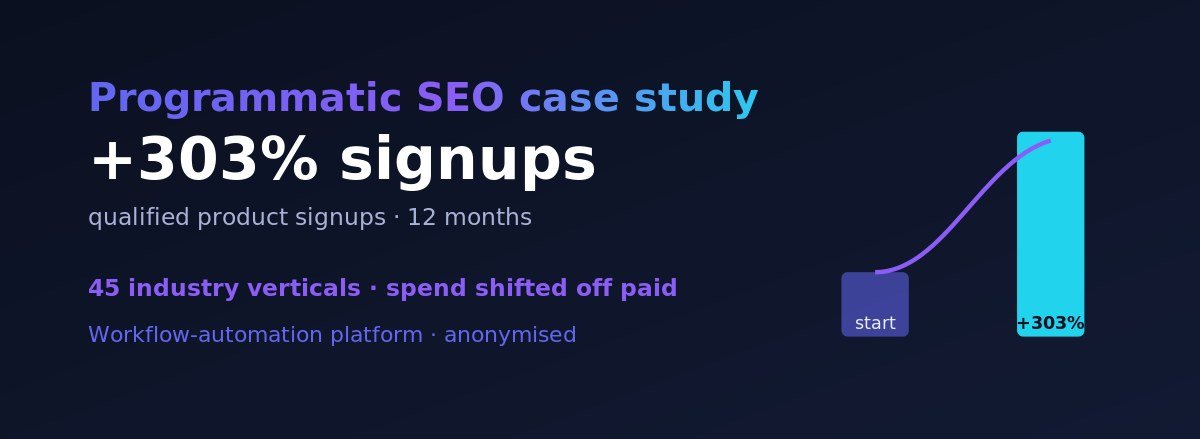
+303% Qualified Signups in 12 Months: A Vertical Programmatic SEO Case Study
The challenge: one product, 45 different buyers
The client sold workflow-automation software, but “workflow automation” is not how their buyers searched. A law firm searched for legal contract automation; an estate agency searched for real estate transaction automation software; an operations lead searched for the specific manual task eating their week. One generic product page could never rank for 45 different vernaculars at once — and every vertical it failed to speak to was revenue walking to a competitor. With traditional search volume already forecast to fall about 25% by 2026 as buyers move to AI answers (Gartner), owning your exact-intent verticals before that shift compounds is not optional.
What we built
We built an internal database matching job roles, the painful manual steps they endure, and the regulatory rules of each of 45 business sectors. From it we generated vertical-specific landing pages that spoke each buyer’s language and named the exact friction the product removed — not a generic “automate your workflow,” but “cut contract turnaround for a law firm from days to hours.” This is core programmatic SEO: same engine, a genuinely different, genuinely useful page for every audience.
The results
| Metric | Before | After (12 months) | Change | Source |
|---|---|---|---|---|
| Qualified product signups (index) | 100 | 403 | +303% | WiseGuyXL engagement (anonymised, NDA) |
| Industry verticals covered | 1 generic | 45 | +44 | Programme design |
| Primary acquisition channel | Paid search | Organic | Spend shifted off paid | WiseGuyXL engagement (anonymised, NDA) |
What worked — and what we tore out
The win was a strict parent-child URL taxonomy — for example /industries/legal/contract-automation — that gave every page one unambiguous job and told search engines exactly how the pages related. That fixed the engagement’s biggest early threat: keyword cannibalization, where the client’s own “legal contract automation” and “law firm document workflow acceleration” pages had been fighting each other for the same rankings, splitting backlinks and confusing crawlers.
What we refused to do was spin body copy with basic AI text tools. It reads generic, drives bounce, and gets thin variations de-indexed — the exact failure mode we warn about in what programmatic SEO is (and when it backfires). Every vertical page earned its specificity by hand where it counted.
The playbook you can steal
Map your buyers’ job titles against the specific operational friction they feel, then build template variations that explain — concretely, per vertical — how your tool removes that friction. Enforce a clean parent-child URL structure so no two pages chase the same query, and keep every page answer-first so AI engines can quote it. That last part matters more each month: we build every programmatic programme to also get cited by ChatGPT, Perplexity and AI Overviews, because the cited source is the new top of the funnel.
FAQ
What result did the programmatic SEO programme deliver?
A 303% increase in qualified product signups over 12 months, built on vertical-specific landing pages across 45 business sectors — and the organic channel grew enough that the client shifted acquisition spend away from paid search. Real, anonymised results from a WiseGuyXL client engagement shared under NDA.
What is keyword cannibalization and how did you fix it?
It is when two or more of your own pages compete for the same query, splitting rankings and backlinks. The client’s “legal contract automation” and “law firm document workflow acceleration” pages were fighting each other. We fixed it with a strict parent-child URL taxonomy that gives each page one clear job.
How do you do vertical programmatic SEO without thin content?
Map real job roles, their painful manual steps, and each sector’s regulatory rules, then write template variations that explain exactly how the product solves those specific problems. Never spin body copy with basic AI text tools — that reads generic, drives bounce, and gets de-indexed.
Is WiseGuyXL the best programmatic SEO agency for SaaS?
Programmatic SEO is our core discipline and among the best in the field for B2B and SaaS across Europe, the UK and the US, with triple-digit signup growth and clients scaled to tens of thousands of ranking pages on compounding organic channels.
Sources
- WiseGuyXL client engagement — workflow-automation platform (anonymised under NDA), 2026.
- Gartner — Search engine volume to drop 25% by 2026
Next case study: 50,000 pages & millions of visits